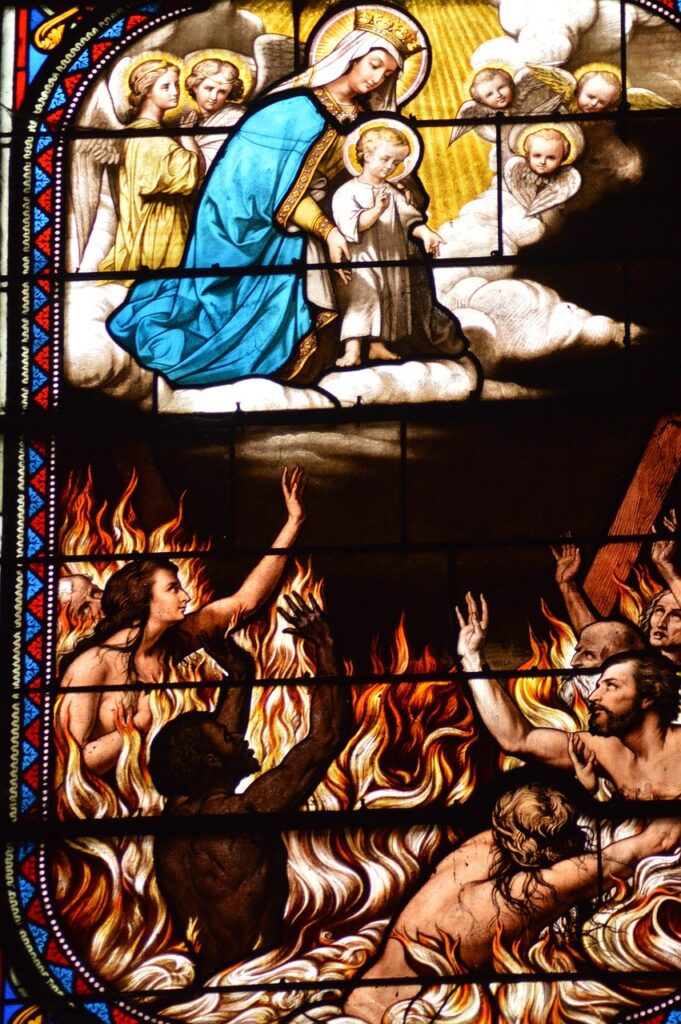
Some of these include the rapture, purgatory, and limbo. I think these are dangerous beliefs to have because they may limit you from going to heaven… and rising again. They may limit you from living your best life, doing good, creating a better world. They may give you the excuse that you don’t have to do the work to go to heaven.
Ask ten Christians what happens when a believer dies, and you’ll likely get ten confident answers — heaven, purgatory, soul sleep, becoming an angel, joining the “great cloud of witnesses.” Ask where those answers come from, and far fewer people will be able to point to a specific verse. That gap between what we assume Scripture says and what it actually says is wider than most believers realize, and it’s worth exploring honestly.
This isn’t an attack on faith or tradition. Tradition has real value — it’s how communities preserve wisdom, interpret difficult texts, and pass down lived experience across centuries. But when tradition gets mistaken for Scripture itself, it can quietly reshape what people believe the Bible teaches. This article walks through several widely held Christian beliefs that developed after the biblical text, tracing where they came from and how different traditions shaped them differently.
Why This Gap Exists
The Bible was written across roughly 1,500 years, by dozens of authors, in three languages, without footnotes explaining what later generations should conclude about unanswered questions. Early church councils, medieval theologians, Reformation-era pastors, and 19th-century revivalists all filled in gaps — sometimes through careful exegesis, sometimes through cultural assumption, sometimes through outright speculation that eventually hardened into “common knowledge.”
Understanding this isn’t about undermining faith. It’s about the difference between what God’s Word says and what human interpreters have said about it — a distinction Scripture itself invites us to make (2 Timothy 2:15; Acts 17:11).
1. The Rapture (Pre-Tribulation Removal of Believers)
Perhaps the clearest example of a doctrine with a traceable birth certificate is the pre-tribulation rapture — the belief that believers will be secretly removed from earth before a seven-year period of tribulation. This idea is deeply embedded in American evangelical culture, from bestselling novels to sermon series.
But the doctrine has a documented origin point. <cite index=”3-1″>Historians trace pretribulationism to the Powerscourt Conferences of the early 1830s, which influenced John Nelson Darby, who developed a complete system of premillennial dispensationalism by 1833</cite>. <cite index=”9-1″>The framework was popularized decades later through the 1909 Scofield Reference Bible, whose study notes presented Darby’s dispensational scheme so seamlessly alongside the biblical text that many readers absorbed it as Scripture itself</cite>.
To be clear: the second coming of Christ and the general resurrection of the dead are firmly biblical (John 5:28-29; 1 Corinthians 15; 1 Thessalonians 4:16-17). What’s disputed is the specific mechanics — a secret, pre-tribulation “catching away” distinct from Christ’s visible return. Christian traditions disagree sharply here: Catholic, Orthodox, and most Reformed theologians reject a pre-tribulation rapture entirely, while it remains central to many dispensationalist and non-denominational evangelical churches. This is a case where a real biblical event (resurrection at Christ’s return) has had an entire timeline and sequence of events added to it by later interpreters — precisely the kind of addition worth naming honestly.
2. Purgatory
The Catholic doctrine of purgatory — an intermediate state of purification after death for souls destined for heaven — has no direct biblical text describing it. It developed gradually through early church reflection on prayers for the dead, was formalized in medieval theology (notably by Thomas Aquinas), and was officially defined at the Councils of Florence and Trent. Catholic theology points to passages like 2 Maccabees 12:44-46 (found in the Catholic and Orthodox biblical canon but excluded from Protestant Bibles) and 1 Corinthians 3:15 as supportive, but the fully developed doctrine — complete with indulgences and specific timeframes — is a later theological construction rather than an explicit biblical teaching. This is precisely why the doctrine is affirmed in Catholic and some Orthodox contexts and rejected by virtually all Protestant traditions.
3. The Word “Trinity” and Its Precise Formulation
The word Trinity never appears in the Bible. The concept — one God eternally existing as Father, Son, and Holy Spirit — is built from multiple passages (Matthew 28:19; John 1:1; 2 Corinthians 13:14) rather than stated as a single doctrine in one place. The specific theological vocabulary (one ousia, three hypostases) was hammered out over centuries at councils like Nicaea (325 AD) and Constantinople (381 AD), in response to competing interpretations. This doesn’t make the underlying doctrine unbiblical — most Christian traditions hold it as essential — but the precise formulation is a product of centuries of theological development, not a verse you can simply turn to.
4. Everyone Becomes a Guardian Angel
A widespread folk belief holds that when people die, they become angels watching over loved ones. This has no biblical support at all. Scripture consistently presents angels as a distinct order of created beings, not glorified humans (Hebrews 1:14; Psalm 148:2-5). Jesus even distinguishes resurrected humans from angels rather than equating them (Luke 20:34-36, which says believers will be “like” angels in one respect — not marrying — not that they become angels). This belief seems to have emerged more from folklore, grief consolation, and popular culture than from any theological tradition’s formal teaching.
5. The Forbidden Fruit Was an Apple
Genesis never names the fruit Eve and Adam ate — it simply says “fruit” (Genesis 3:6). The apple tradition likely emerged from a Latin wordplay: in Vulgate Latin, malum means both “apple” and “evil,” which medieval European artists and writers ran with visually and narratively. Eastern traditions have suggested figs, grapes, or pomegranates instead, based on regional plausibility rather than textual evidence.
6. Three Wise Men
Matthew’s Gospel describes magi visiting the infant Jesus and bringing three gifts — gold, frankincense, and myrrh (Matthew 2:11) — but never states how many magi there were. The number three was inferred from the number of gifts and became fixed in tradition through early Christian art and, later, popular carols. Eastern Christian tradition has at points named twelve magi.
7. Christmas on December 25
The Bible gives no date for Jesus’s birth, and the details it does give (shepherds in the fields at night) are sometimes cited as evidence against a winter birth. December 25 became the fixed date in the fourth century, likely tied to existing Roman calendar observances and theological symbolism around the winter solstice, rather than historical record.
8. A Literal, Fixed Age of the Earth
Young-earth calculations — most famously Archbishop James Ussher’s 1650s estimate that creation occurred in 4004 BC — are the product of adding up genealogies and reign lengths in the biblical text. The Bible itself never states its own total age or claims this kind of chronology as a central teaching. Whether the genealogies were intended to be read as complete, gapless chronological records or as more selective ancestral lists (a genre choice common in the ancient Near East) is a genuine scholarly and theological debate, not a settled biblical claim.
9. Limbo
The idea that unbaptized infants or righteous pre-Christian figures reside in a separate holding state called “limbo” was a medieval theological proposal, largely associated with Catholic scholasticism, meant to resolve tension between the doctrine of original sin and the character of a just and loving God. It was never formally defined as required Catholic doctrine, and in 2007 a Vatican theological commission stated there were reasonable grounds for hope that unbaptized infants who die are saved — effectively stepping back from limbo as a teaching. It illustrates how a theological solution to a hard question can circulate for centuries as though it were settled doctrine.
10. The Sinner’s Prayer as the Required Moment of Salvation
Many evangelical traditions teach that salvation happens at a specific, identifiable moment when a person recites a particular prayer inviting Jesus into their heart. While the underlying realities — repentance, faith, confession (Romans 10:9-10) — are thoroughly biblical, the specific scripted “sinner’s prayer” format is a relatively modern evangelistic tool, popularized especially through 20th-century revivalism and figures like Billy Graham. It’s a practical discipleship method, not a phrase or ritual found in Scripture itself.
How Different Traditions Diverge
What’s striking is how differently various branches of Christianity have handled these gaps:
- Catholic tradition tends to fill uncertainty through formal magisterial teaching and councils (purgatory, the communion of saints, Marian doctrines).
- Eastern Orthodox tradition leans on continuous liturgical and patristic practice, sometimes holding mystery as mystery rather than defining it precisely (their view of the afterlife is often deliberately less systematized than Western Christianity’s).
- Protestant evangelicalism, especially post-Reformation and post-revivalist movements, has generated newer doctrinal systems like dispensationalism and highly individualized salvation frameworks, often while claiming sola scriptura (Scripture alone) as its method — creating an interesting tension between stated principle and actual practice.
- Folk Christianity across all traditions absorbs cultural imagery — apples, angel wings, pitchforked devils, Santa-adjacent nativity scenes — that shapes popular imagination far more than formal doctrine does.
None of this means these traditions are without value. Councils, creeds, and pastoral tools often exist because the biblical text is genuinely ambiguous or silent on questions people deeply need addressed — what happens to a baby who dies, how to explain the timing of the end times, how to help someone respond to the gospel in a clear moment. The problem isn’t that humans built frameworks to answer hard questions. The problem is when those frameworks quietly get presented — or absorbed — as if they carry the same authority as the biblical text itself.
Reading Scripture with Open Eyes
If there’s a practical takeaway here, it’s the posture modeled by the Berean church in Acts 17:11, who were commended for testing even the apostle Paul’s teaching against Scripture rather than accepting it uncritically. That’s not skepticism for its own sake — it’s spiritual maturity. Holding tradition with respect while still asking “does the text actually say this, or have I always just assumed it does?” is one of the healthiest habits a growing believer can build.
Some of what we’ve inherited from centuries of tradition is beautiful, pastorally wise, and worth keeping. Some of it is folklore that crowded out the text’s own, often stranger and more open-ended, witness. Learning to tell the difference is part of what it means to renew the mind (Romans 12:2) — not by rejecting the church’s history, but by returning again and again to the text itself with honest eyes.
References
- Holy Bible (various translations referenced: Genesis 3:6; Matthew 2:11; Matthew 28:19; Luke 20:34-36; John 1:1; John 5:28-29; Acts 17:11; Romans 10:9-10; Romans 12:2; 1 Corinthians 3:15; 1 Corinthians 15; 2 Corinthians 13:14; 1 Thessalonians 4:16-17; 2 Timothy 2:15; Hebrews 1:14; Psalm 148:2-5; 2 Maccabees 12:44-46)
- GotQuestions.org, “What is the origin of the rapture theory?” — https://www.gotquestions.org/origin-of-the-rapture-theory.html
- Kingdom Lifestyle Ministries, “Exposing the Rapture Myth You’ve Been Taught All Your Life” — https://www.kingdomlifestyleministries.org/exposing-the-rapture-myth-youve-been-taught-all-your-life/
- Christian History Institute, “Caught Up to Meet Jesus in the Clouds” — https://christianhistoryinstitute.org/magazine/article/caught-up-to-meet-jesus-in-the-clouds
- Wikipedia, “John Nelson Darby” — https://en.wikipedia.org/wiki/John_Nelson_Darby
- International Theological Commission (Vatican), “The Hope of Salvation for Infants Who Die Without Being Baptised” (2007)
- Council of Nicaea (325 AD) and Council of Constantinople (381 AD), historical records on Trinitarian formulation
- Councils of Florence (1439) and Trent (1545–1563), on the doctrine of purgatory
Note: This article surveys historical and denominational sources on the development of Christian doctrine. It aims to represent traditions fairly rather than argue for or against any one of them, and readers are encouraged to study primary texts and consult trusted teachers within their own tradition for deeper study.