Few artifacts capture the human imagination quite like the Book of the Dead. Painted on papyrus, sealed inside coffins, and tucked beside the mummified bodies of ancient Egyptians, this collection of spells has become one of the most recognizable windows into a civilization obsessed with one central question: what happens after we die?
But the Book of the Dead is often misunderstood — treated as a single, static “book” rather than what it actually was: a living, evolving body of sacred literature. And the world that produced it is just as misunderstood. Ancient Egypt is frequently imagined as a society built on the backs of enslaved masses, forced to raise monuments for the elite. The archaeological record tells a far more complicated, and in many ways more remarkable, story.
This post explores the real history of the Book of the Dead, its core theology of eternal life, how that hope became available to ordinary Egyptians rather than remaining a royal privilege, and what we now know about prosperity, daily life, and the people who actually built the pyramids.
What Is the Book of the Dead, Really?
The Book of the Dead is not a single text with one author, one edition, or one fixed table of contents. It is a modern name — coined by German Egyptologist Karl Richard Lepsius in 1842 — for a collection of roughly 190 individual spells, hymns, and instructions that ancient Egyptians called the “Book of Coming Forth by Day.”
That original title matters. The Egyptians weren’t writing a manual about death. They were writing a guide about continued life — about how a soul moves through the dangers of the underworld and emerges into the light on the other side. Each copy of the “book” was customized. Wealthier families could commission longer, more elaborately illustrated scrolls with dozens of spells; more modest households might afford only a handful of the most essential ones. There was no single canon everyone was required to follow, which makes the collection feel less like scripture in the rigid sense and more like a flexible toolkit for the afterlife journey.
From Pyramid Texts to Coffin Texts to the Book of the Dead
The spells that eventually became the Book of the Dead didn’t appear overnight. They represent the final stage in a tradition of funerary literature that developed over more than a thousand years.
Pyramid Texts (c. 2400–2300 BCE): The oldest religious writings in the world, carved into the interior walls of royal pyramids during the Old Kingdom. These spells were reserved exclusively for pharaohs, believed to guarantee their transformation into divine, eternal beings.
Coffin Texts (c. 2100–1700 BCE): During the Middle Kingdom, the same protective spells began appearing on the coffins of nobles and officials — not just kings. This shift was theologically significant. Eternal life was beginning to extend beyond the throne.
The Book of the Dead (c. 1550 BCE onward): By the New Kingdom, the spells had migrated again — this time onto papyrus scrolls, making them portable, reproducible, and, crucially, purchasable. Scribes could copy blank versions in advance and leave space to fill in a buyer’s name, meaning any family with enough resources to pay a scribe could obtain a copy for a loved one’s burial.
This progression — from pyramid wall, to coffin, to papyrus scroll — is really a story about access. Something that began as the exclusive property of god-kings gradually became available to merchants, craftsmen, and eventually a much broader swath of Egyptian society.
The Core Belief: Eternal Life and the Weighing of the Heart
At the heart of the Book of the Dead is a conviction that shaped nearly every aspect of Egyptian religious life: death was not an ending. It was a transition, and how a person navigated that transition determined whether they would live forever.
The most famous scene associated with this belief is the Weighing of the Heart, depicted in Spell 125. In this scene, the deceased stands before Osiris, god of the afterlife, while the jackal-headed god Anubis places their heart on one side of a scale. On the other side sits the feather of Ma’at — the goddess representing truth, balance, and cosmic order. If the heart is lighter than the feather, the person is declared “true of voice” and welcomed into the eternal fields of the afterlife. If the heart is heavy — weighed down by wrongdoing — it is devoured by the monster Ammit, and the person ceases to exist entirely.
Before this weighing takes place, the deceased recites what scholars call the Negative Confession — a list of 42 declarations denying specific sins, addressed to 42 different divine judges. Statements like “I have not stolen,” “I have not caused pain,” and “I have not told lies” function less like a legal defense and more like a moral self-examination, an accounting of a life measured against a shared standard of right conduct.
What’s striking here is how ethical this cosmology is. Eternal life in ancient Egyptian belief wasn’t purely about status, wealth, or royal bloodline. It was tied to how a person had lived — to honesty, justice, and care for others. That moral framework is part of what makes the Book of the Dead such rich material for comparative religious study; the conviction that the quality of a life determines the quality of an eternity echoes across many faith traditions, even where the specific theology diverges sharply.
Available to All: The Democratization of the Afterlife
Egyptologists often describe the shift from Pyramid Texts to the Book of the Dead as the “democratization of the afterlife,” and it’s worth sitting with how significant that change really was.
In the earliest period of Egyptian religion, eternal life was not a universal hope — it was a royal monopoly. Only the pharaoh, as a semi-divine figure, was believed to have automatic access to resurrection and life among the gods. Everyone else’s fate was far less certain.
Over the centuries that followed, that exclusivity eroded. Nobles gained access through the Coffin Texts. Then, by the New Kingdom, any family who could afford a scribe’s services could commission a Book of the Dead papyrus for a deceased relative — official, priest, farmer, or craftsman. Quality and length varied enormously based on wealth (a pharaoh’s version might run over a hundred spells with lavish illustrations, while a modest household might purchase a short scroll with only a dozen), but the underlying promise was, in principle, extended to anyone with the means to participate.
This is an important nuance for anyone drawing comparisons to other sacred traditions: access had expanded dramatically compared to the Old Kingdom, but it was not entirely free of economic barriers. Wealth still shaped the quality and completeness of one’s spiritual provisions, even as the theological door had swung open to ordinary people in a way it never had before.
A Brief History of Ancient Egypt
To understand the Book of the Dead, it helps to understand the civilization that produced it across roughly three thousand years of history.
Predynastic and Early Dynastic Period (c. 6000–2686 BCE): Communities along the Nile unified into a single kingdom under the first pharaohs, laying the foundation for centralized religion and writing.
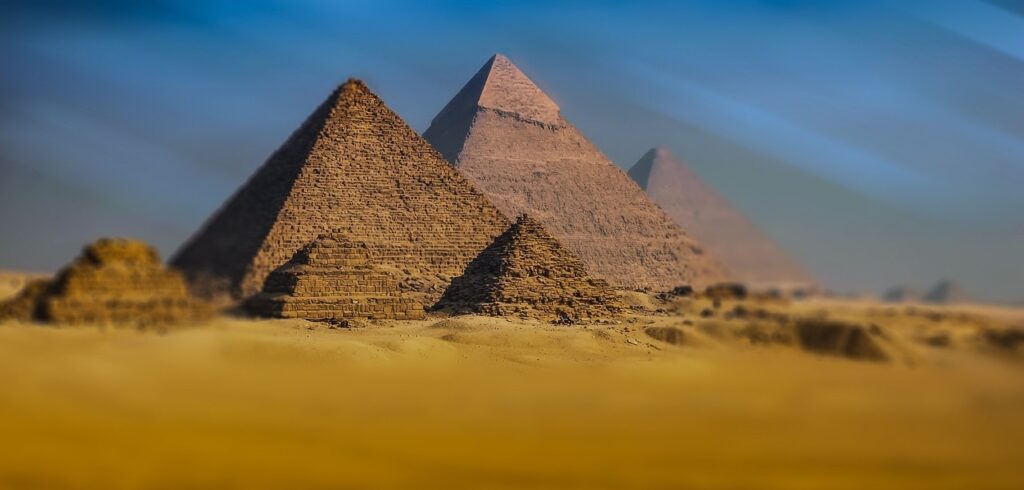
Old Kingdom (c. 2686–2181 BCE): Known as the “Age of the Pyramids.” This era produced the Pyramid Texts and the great monuments at Giza, including the Great Pyramid of Khufu.
Middle Kingdom (c. 2055–1650 BCE): A period of political stabilization and cultural flourishing, during which the Coffin Texts emerged and funerary religion began extending to non-royal elites.
New Kingdom (c. 1550–1070 BCE): Egypt’s imperial golden age, home to famous rulers like Hatshepsut, Akhenaten, Tutankhamun, and Ramesses II. This is the era in which the Book of the Dead took its recognizable papyrus form.
Late Period and beyond (c. 664–30 BCE): Egypt faced successive foreign rule — Persian, then Greek under the Ptolemaic dynasty — before becoming a Roman province in 30 BCE, closing three millennia of pharaonic civilization.
Throughout these shifting eras, religious belief remained a remarkably consistent thread — a civilization-long preoccupation with order, justice, and the hope of life beyond death.
Prosperity in Ancient Egypt
Ancient Egypt’s prosperity was built on one geographic gift: the Nile. Its predictable annual flooding deposited nutrient-rich silt across the surrounding land, producing agricultural surpluses that were rare in the ancient world. That surplus fed a complex economy — one with organized labor, skilled trades, long-distance trade networks reaching into the Levant, Nubia, and the Aegean, and a state sophisticated enough to coordinate massive building projects.
Prosperity in Egyptian thought wasn’t purely material, either. Ma’at — the same principle of truth and balance central to the Weighing of the Heart — was understood as the force that made a flourishing society possible at all. A prosperous Egypt was one in balance: where the Nile flooded on schedule, where justice was upheld, and where the living maintained right relationship with the gods and with one another. Wealth and moral order were seen as deeply intertwined, not separate categories.
The Pyramid Builders: Homes, Food, and Honor — Not Slaves
Perhaps no myth about ancient Egypt has proven more durable, or more inaccurate, than the idea that the pyramids were built by enslaved masses driven by the whip. Popular imagination — shaped by Hollywood epics more than by archaeology — has long pictured a labor force of foreign captives worked to death under brutal overseers.
Excavations at Giza since the 1990s, led by archaeologist Mark Lehner and his team, tell a strikingly different story. Researchers uncovered an entire purpose-built settlement adjacent to the pyramids — now often called the “Lost City of the Pyramid Builders” — complete with worker housing, bakeries capable of producing large quantities of bread, and breweries brewing beer, which served as both nourishment and payment. Evidence points to a workforce fed substantial rations of meat, bread, and beer, suggesting laborers were far better provisioned than the enslaved-labor myth suggests.
Skeletal remains recovered from nearby worker cemeteries show signs of healed bone fractures, indicating injured laborers received medical care and time to recover rather than being discarded. Some workers were buried in tombs near the pyramids themselves — a position of considerable honor in Egyptian belief, reserved for those thought worthy of proximity to sacred ground, not a treatment typically extended to slaves.
Most researchers now believe the workforce was largely made up of Egyptian citizens — likely organized through a rotating labor system tied to agricultural cycles, when Nile floodwaters made farming impossible and laborers could be redirected to state building projects, possibly alongside an element of religious or civic duty rather than pure coercion. Skilled crews appear to have taken pride in their work: graffiti left by work gangs inside the pyramid structures includes team names that translate roughly to boastful titles, suggesting builders who saw themselves as accomplishing something significant rather than merely enduring forced labor.
None of this means ancient Egyptian labor was free of hardship — it was almost certainly demanding, physically brutal work by modern standards, and Egypt did practice various forms of forced labor and enslavement in other contexts throughout its history. But the specific claim that the pyramids themselves were raised by whipped slave gangs does not hold up against the archaeological evidence uncovered at the Giza worker’s village.
Closing Reflection
The Book of the Dead endures because it speaks to something universal: the hope that life, meaning, and moral accountability extend beyond the grave. What began as a privilege reserved for god-kings gradually opened into a promise available to ordinary people — a trajectory that mirrors a pattern found across many of history’s sacred traditions, where the hope of eternal life expands outward from the few to the many. Understanding that history, alongside the genuine prosperity and dignity evident in the lives of everyday Egyptians — pyramid builders included — gives us a fuller, more honest picture of a civilization that shaped how humanity has thought about mortality, justice, and eternity ever since.